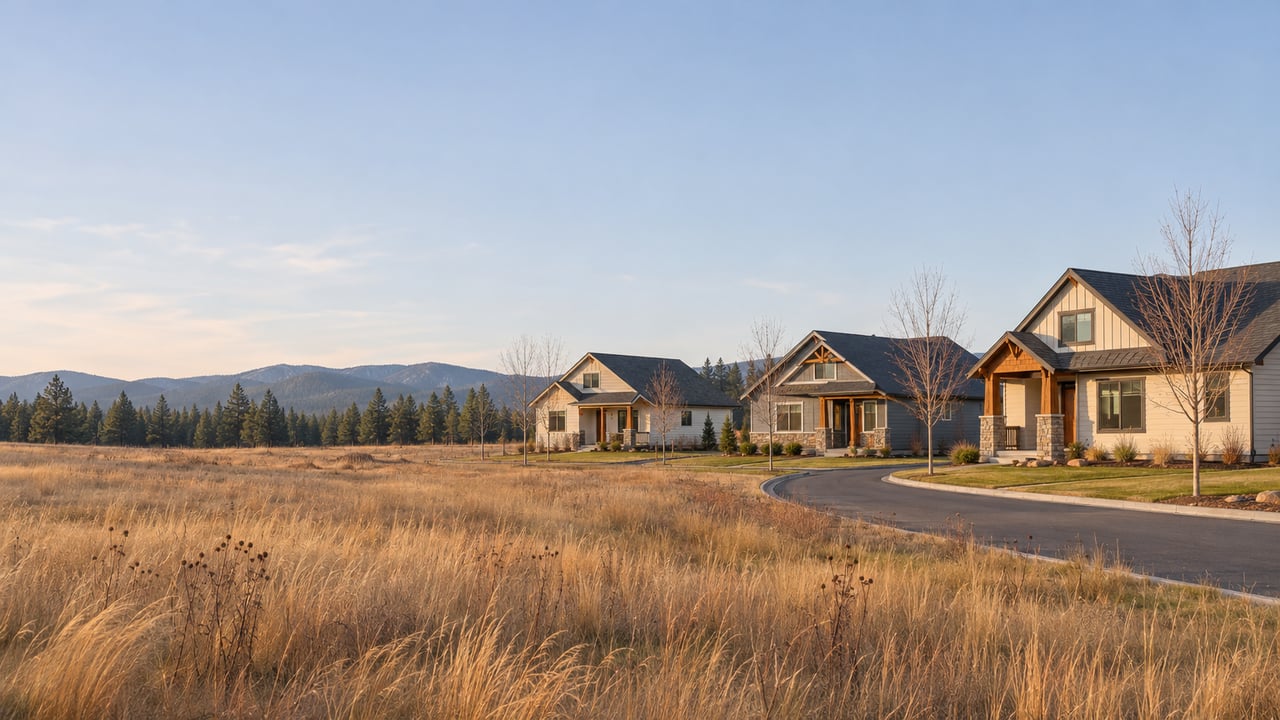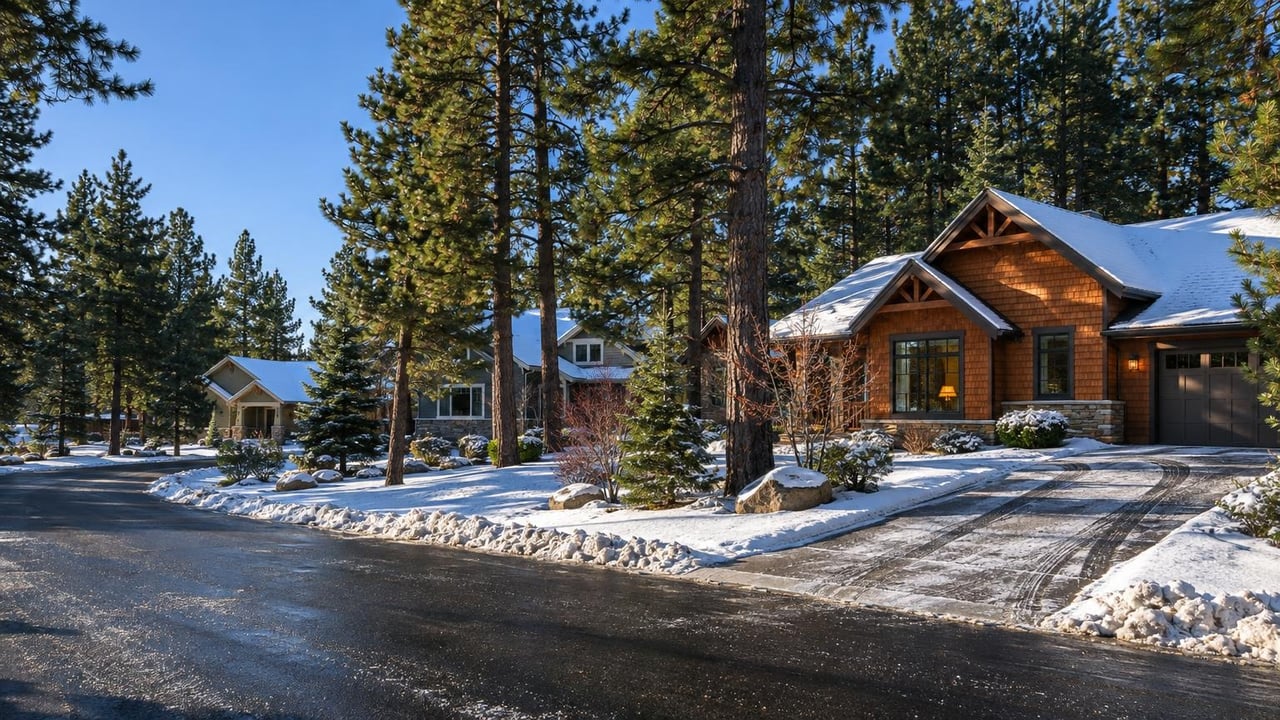
The street that looks worst in a snowstorm is often not the one that keeps a car in the garage longest. Coeur d'Alene's Winter Operations Plan puts Cherry Hill, Tubbs Hill, Stanley Hill, Fernan Hill, Fernan Terrace Drive, Lakewood Drive and Armstrong Hill second in line for the plows, ahead of every flat residential street in the city. The level, tree-lined blocks near downtown come last.
If you're comparing Coeur d'Alene neighborhoods this winter, start with something other than slope. A snow morning at a given address depends on three things: where the street falls in the city's plow order, which agency's truck plows it, and whether the garage opens onto the street or onto an alley. Coeur d'Alene gets an average of nearly four feet of snow a year, Streets and Engineering Director Todd Feusier told the City Council in December 2025, as the Coeur d'Alene Press reported in January 2026.
The order the trucks follow
The city's Winter Operations page links to a Council-adopted plan and sets a goal of clearing the whole community within 40 hours. Under the plan itself, the Streets and Engineering Director calls a citywide plow when more than 4 inches of snow is on the road, or when 3 inches is down and more than 4 inches is forecast. Crews start at 4 a.m. in the downtown business district and work in continuous shifts until every street is done, which takes about 40 hours.
The order is set in writing. Priority 1 is the arterials and the streets around the hospital, the fire stations, the police department and the 911 Dispatch Center. Priority 2 is collector streets, school-bus routes and the named steep hills. Priority 3 is residential areas, and plowing there starts only after Priority 2 is finished. Once every street is passable, removing the center berms becomes the top job.
Ice treatment follows the same split. The plan says pre-treating and de-icing begin when temperatures are between 32 and 15 degrees, with liquid and granular products going on "arterials, collectors and hills." Residential areas "will receive sanding as needed."
In a citywide event, a flat residential street in the middle of town is the last kind of street to see a plow, and it gets sand where the hills get de-icer.
Hill streets get plowed early and keep a full berm
Cherry Hill is the clearest example. A Coeur d'Alene Press neighborhood profile described the neighborhood, also called Cherry Heights, as sitting on the city's eastern edge "overlooking the town," with winding roads, rock outcroppings, trees and views. Most of its homes went up in the late '60s and early '70s. On the first real snow of last winter, the Press reported on December 3, 2025 that people were out sledding at Cherry Hill Park.
Cherry Hill is on the Priority 2 list, so its main roads get plowed and treated before most of the city. The cost of that position shows up at the end of the driveway. The city has five snow gates, which are blades that hold back snow as the plow passes a driveway, and the plan says that's enough to give every residential area gate service. The same plan also says "snow gates generally will not be used on arterials/collector streets due to the large volume of snow pushed to the curb on wider streets."
That makes the gate the real difference between a hill street and a residential one. Feusier told the Council the gates cut residential berms "to 6 inches on each side of your driveway," according to the Press. The city's own winter page says the gates "significantly reduce the snow berm" but "do not eliminate it." A house that faces one of the named hill streets gets an early plow. It also gets whatever berm the plow leaves at the driveway, with no gate to hold it back.
Tubbs Hill shows up on the same Priority 2 list. If you've walked the hill this fall, our earlier post on the fire mitigation work on Tubbs Hill covers the trail side.
Fernan and Armstrong Park run on a different agency's rules
Fernan and Armstrong Park are plowed by a different agency. The city plan says snow gates "are not used in areas that are plowed under cooperative agreement by East Side Highway District (Fernan and Armstrong Park)." East Side Highway District says its maintenance area reaches slightly inside Coeur d'Alene city limits and runs east to the Shoshone County line.
East Side has its own written priorities and triggers. Its snow policy, adopted in February 2008, puts school-bus routes, steep grades, sharp curves with heavy traffic, busy intersections and major collectors first. It sets a minimum snow depth of 2 to 4 inches during the regular work week and 4 to 6 inches on weekends and recognized holidays. The policy also says the district is not responsible for driveway berms and "shall not plow or sand on private property" except in specified emergencies.
Armstrong Park sits inside that agreement area. A Press profile of Armstrong Park described it as "high in the hills above Lake Coeur d'Alene," with winding roads, forested lots and lake views. Some lots near the top of Sky Harbor Drive look out on both Fernan Lake and Lake Coeur d'Alene. The first homes there went up in 1989, and Falcon Ridge is a smaller gated section with higher-priced homes. The Centennial Trail runs along the bottom of the hill.
In Armstrong Park, the views and both lakes come with East Side's thresholds, East Side's priority list and no snow gate. Buyers who see a Coeur d'Alene address and expect the city's 40-hour plan should know that the streets up the hill run on a different agency's schedule.
The flat grid, and the alley the city doesn't plow
The Garden District has the opposite profile. The National Register nomination form, posted by the city, describes the city's first residential neighborhood as roughly 132 acres bounded by 11th Street, Montana Avenue, 5th Street and Lakeside Avenue. It's laid out as "a cardinal direction-oriented grid with alleys," and the form lists alleys and outbuildings among the district's defining features. The Press reported in May 2025 that most of the district's homes were built between 1890 and 1940. In the nomination's survey, most outbuildings, garages included, face the alleys.
Feusier stated the alley policy plainly in the Press. The street department "doesn't plow alleyways." In an alley-loaded block, the snow gate that cuts the berm to about 6 inches protects the curb in front of the house. The car comes and goes through the alley in back, and no city truck clears it.
Fort Grounds, between North Idaho College and City Park, is similar. A Press profile of Fort Grounds called it one of Coeur d'Alene's first neighborhoods, with about 110 homes on narrow, tree-lined streets and many houses more than 100 years old. A 2016 city survey of Fort Grounds records at least one garage reached from an alley. That's one property, so check each house rather than assuming the whole neighborhood works that way.
The old grid makes up for some of this. These are the neighborhoods closest to Sherman Avenue, City Park and the lake, where a snowy morning can still be done on foot. If you're comparing lake-adjacent blocks near downtown, our post on the dock ban at Sanders Beach covers a separate difference that the price alone won't show either.
North of Best Avenue, check the agency map
Coeur d'Alene's north side adds another agency. Lakes Highway District maintains public roads in northern Kootenai County, and its boundary generally starts north of Best Avenue. The district begins plowing at two inches or after a storm lets up, clears major collectors before school-bus routes and local subdivisions, and treats steep grades and intersections selectively. It points residents to its service-area map to find out which agency is responsible for a road. A road that isn't on its map may belong to another highway district, the county, the state or a private association.
The city's Snow & Ice Control Plan says the City does not clear snow from private property or private driveway accesses unless the Incident Commander declares an emergency. For a house on a private road, the person to ask about plowing is whoever maintains that road.
Questions for a winter showing
Showings between now and March are the best chance to see a street the way it will look in January. Before writing an offer, find out three things. First, which agency plows the street: the city, East Side under the cooperative agreement, Lakes Highway District, or a private association. Second, whether the street is on the city's Priority 2 hill list or in the residential tier. Third, where the garage opens. A Garden District bungalow, a house on Cherry Hill and a house up Sky Harbor Drive can all carry a Coeur d'Alene address, and each one gets a different snow morning.
If you're selling a home on one of these streets this winter, the plow schedule is part of what a buyer is pricing, and an early-plowed hill street or a walkable grid block is worth pointing out in the listing. Ask ExSell Realty Group for a free home valuation, and tell Donnie and Amy which agency plows your street and where your garage opens. We'll build both into how we price and market the house.